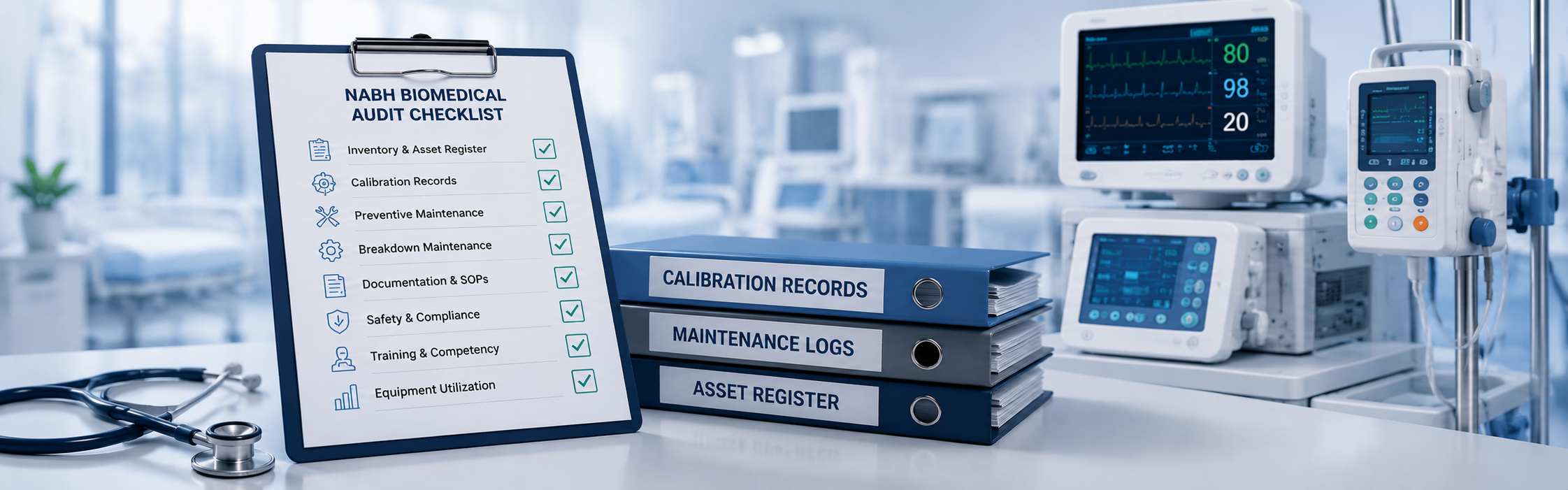
Why Indian Hospitals Keep Failing NABH Biomedical Audits — And What the Checklist Actually Demands
Why Indian Hospitals Keep Failing NABH Biomedical Audits — And What the Checklist Actually Demands
NABH assessors are not checking whether your equipment works. They are checking whether you can prove — with linked, traceable documentation — that it has been managed correctly. Most hospitals cannot. Here is what the checklist actually requires.
Ask any NABH assessor what the most common reason for non-conformance is during a hospital accreditation audit. Almost all of them will say the same thing: biomedical documentation.
Biomedical equipment records account for a disproportionate share of non-conformances during initial accreditation and re-accreditation cycles across hospitals in South India. The gap is not in the equipment itself. Hospitals have ventilators, monitors, and diagnostic machines. The gap is in proving — on paper, on demand, in front of an assessor — that those assets are being managed correctly.
Most hospital administrators are genuinely surprised when they first see what NABH's biomedical standards actually require. The checklist is not about whether your equipment works. It is about whether you can prove, with complete and traceable documentation, that your equipment is serviced on schedule, calibrated on time, maintained by qualified personnel, and ready for patient use at any moment.
This post walks through what that checklist actually demands, where most hospitals fall short, and what a realistic 30-day path to audit readiness looks like.
1. What NABH's Biomedical Audit Checklist Actually Covers
The NABH standards most relevant to biomedical equipment fall primarily under the Management of Equipment (ME) chapter. This chapter expects hospitals to demonstrate that they operate a systematic, documented, and verifiable equipment management programme — not ad hoc maintenance, not informal service arrangements, not memory-based scheduling.
Here is what ME chapter assessors look for across key elements:
Equipment Inventory and Asset Register
Every piece of biomedical equipment must be recorded in a master equipment register. This is not just a count of machines — it requires serial numbers, model numbers, acquisition dates, installation dates, location by department, and the name of the responsible department head. An inventory that lives in someone's memory or in an unlabelled Excel file does not satisfy this requirement.
Preventive Maintenance (PM) Schedules
For each piece of equipment, there must be a documented preventive maintenance schedule — typically based on manufacturer recommendations and usage frequency. The schedule must show planned PM dates and completed PM dates. Gaps between planned and actual service dates are flagged. Missing months in a PM log are a non-conformance.
Calibration Records
Any equipment used for measurement — blood pressure monitors, infusion pumps, glucometers, pulse oximeters, weighing scales, thermometers, and all diagnostic devices — must have current calibration certificates from an accredited calibration laboratory. The certificates must be physically linked to the specific device by serial number, within validity, and renewed on schedule.
Breakdown and Incident Records
Every equipment failure, complaint, or incident must be logged with date, nature of complaint, downtime, corrective action taken, and resolution date. Unrecorded breakdowns — even if the equipment was repaired — are a documentation failure.
Warranty and AMC Records
Active AMCs (Annual Maintenance Contracts) must be on file, linked to the relevant equipment. Warranty expiry dates must be tracked. Equipment serviced after warranty expiry without an AMC in place is a red flag.
Equipment-Specific Training Records
Biomedical engineers and clinical staff operating equipment must have documented competency records. This includes training attendance registers, induction records, and periodic re-training documentation for critical equipment categories.
2. The 6 Most Commonly Failed Documentation Items
Across our work with hospitals preparing for NABH assessment, six documentation failures appear repeatedly. They are not obscure requirements. Most hospital teams know they should have these records. The problem is the system — or lack of one — for maintaining them consistently.
Calibration certificates not linked to specific devices
A hospital might have certificates on file. But if they are not linked by serial number to specific equipment, an assessor cannot verify that the calibrated device and the device in use are the same machine.
PM logs with gaps or no completion signatures
A PM schedule is not the same as a PM record. Assessors look for completion signatures, dates, findings, and the name of the person who performed the service.
Breakdown incidents that were never formally logged
Most hospitals handle breakdowns informally — a WhatsApp message, a phone call. There is no formal incident ticket, no recorded resolution timeline. When an assessor asks to see the incident log, a blank record creates serious doubt.
AMC documents expired or missing for high-value equipment
Equipment being serviced informally — without a current AMC or documented rate contract — has no traceable record of who serviced it, when, and to what standard.
Equipment transferred between departments with no movement record
Equipment moved without documentation creates an inventory discrepancy. The master register shows the equipment in one location. The assessor finds it in another.
No documented condemnation or retirement criteria
When equipment is taken out of service, there must be a documented condemnation process with rationale, approval signatures, and disposal record. Equipment that simply disappears from the register is a documentation failure.
3. Why Spreadsheets and Paper Registers Fail Audit Readiness
The honest answer to why so many hospitals fail on biomedical documentation is not negligence. It is infrastructure. The tools most hospitals use were never designed for NABH audit readiness.
Paper registers are the most fragile documentation system possible. They depend on the physical presence of the register, the legibility of whoever last updated it, and the institutional knowledge of the person who maintains it. When that person is on leave or leaves the hospital, the information is often practically inaccessible.
Excel spreadsheets are an improvement — but only marginally. A spreadsheet does not send reminders when PM dates are due. It does not alert you when a calibration certificate is about to expire. It does not link a breakdown incident to a specific asset's complete service history. It requires someone to open it, remember to update it, and know where to find it. In a busy hospital, that chain of dependency breaks constantly.
A NABH assessor does not just want to see that records exist. They want to follow a thread: this specific device, identified by serial number, was received on this date, installed here, serviced by this person on these dates, calibrated by this lab on this date, incident recorded on that date, resolved in this many hours. That thread is nearly impossible to reconstruct from paper and spreadsheets without significant manual effort.
4. What 'Complete Biomedical Records' Actually Means in NABH Language
When an assessor asks for complete equipment records, they mean a specific, interconnected set of documents for each asset. For each piece of equipment, complete records means:
- 1The asset profile — manufacturer, model, serial number, procurement date, cost, department, responsible person, warranty period, current AMC status.
- 2The maintenance history — every PM performed, with date, technician name, findings, actions taken, and sign-off. Every breakdown incident, with date of failure, complaint, downtime duration, corrective action, root cause, and resolution date.
- 3The calibration history — every calibration performed, with calibration date, calibrating agency, certificate number, next due date, and validity confirmation.
- 4Training and competency records — documentation that authorised personnel are trained to operate the equipment, with training dates and evidence of competency assessment.
- 5Disposal or condemnation record (when applicable) — the formal decision to retire equipment, with reasoning, approval, and disposal documentation.
The key word here is linked. These records must be traceable to the specific device by serial number — not to a category or department. A general service log for "all ventilators in ICU" does not satisfy individual asset documentation requirements. This is the single most common misunderstanding that leads to non-conformances.
5. A Practical 30-Day NABH Audit Readiness Framework
If your hospital has a NABH assessment coming up, or if you want to build a system that is always audit-ready rather than crisis-ready, here is a realistic 30-day framework. This is the minimum foundation for documentation that will hold up under scrutiny.
6. The System Problem Has a System Solution
The 30-day framework above works. But it also reveals a deeper issue: audit readiness built through a one-time scramble is not the same as a hospital that is genuinely, continuously compliant.
The hospitals that pass NABH biomedical assessments with minimal non-conformances are not the ones that work hardest in the month before the audit. They are the ones that have a system — one that logs PMs as they happen, sends calibration reminders before certificates expire, records every incident at the time of occurrence, and makes the complete asset record retrievable in seconds.
That system does not have to be complicated. It has to be consistent.
Vajra is a biomedical equipment management software built specifically for Indian hospitals.
Vajra by Proteger AI Pvt. Ltd. digitises every NABH ME chapter requirement — asset inventory, preventive maintenance scheduling, calibration certificate tracking, incident management, AMC monitoring, and NABH-ready audit report generation. Accessible from both mobile (Android + iOS) and web.
Used by hospitals across Karnataka, Andhra Pradesh, Telangana, and Tamil Nadu.
Is your hospital NABH audit-ready today?
Download our free NABH Biomedical Audit Readiness Checklist — every ME chapter requirement mapped into a hospital-actionable format, used by biomedical teams across 25+ hospitals.